10 Minimalist Circular TV Wall Partition Ideas for a Modern TV Panel Unit
A circular TV wall partition solves a problem straight walls can’t. It divides a room without closing it off, letting light and sightlines pass around the curve while still giving the TV a defined spot to live.
This shape works especially well in open concept homes, where a full wall would feel too heavy but a bare TV mount would feel too plain. The circle softens the division, and it reads as a design feature rather than a wall you added out of necessity.
Here are 10 ways to design a circular TV wall partition for a modern living space. A few need real construction planning. Others are far simpler and can be added to an existing room without touching a single stud.
1. Use a Wood Ring Partition Behind the TV

A wood ring frame, built around the TV and mounted to a slim support wall, is one of the more approachable versions of this idea. The ring itself can be painted or left in a natural finish, depending on how much warmth you want in the room.
Keep the ring thickness proportional to the TV size. A screen larger than about 55 inches usually needs a ring at least 8 to 10 inches thick to look balanced instead of flimsy.
Mounting Notes
The support wall behind the ring needs enough structure to hold the TV’s weight, so this isn’t purely decorative. Plan the framing with an installer before committing to a final design.
A natural wood finish tends to read as more contemporary than a stained or painted ring. If warmth is the goal, though, a walnut or oak stain can soften the geometry of the circle even further.
2. Add a Stone Clad Circular Panel

A circular panel finished in stone veneer adds weight and texture that wood alone can’t match. This works well as a true room divider, since the density of stone reads as a permanent fixture rather than a lightweight accent.
Choose a lighter stone tone if the space doesn’t get much natural light. Dark stone in a dim room can make the circular shape disappear into the wall instead of standing out as a feature.
Weight is worth considering early too. Stone cladding adds real mass to the partition, so the support structure needs to be planned for that load from the start rather than added as an afterthought.
3. Try a Metal Ring Frame for an Industrial Look

A slim black metal ring around the TV brings an industrial edge that softer materials don’t. The thin profile also keeps the shape from feeling bulky, which matters in smaller open concept spaces where a heavier partition would eat into the room.
Pair a metal ring with warmer furniture nearby, like a wood coffee table or leather seating. This balances the coolness of the metal instead of letting the whole space feel sharp and cold.
A thin ring profile, closer to half an inch than a few inches, keeps the industrial look from feeling heavy. The thinner the frame, the more the eye focuses on the TV and the negative space around it rather than the ring itself.
4. Use a Circular Cutout to Divide Living and Dining

Rather than a solid partition, a circular cutout in a slim wall lets you see through to the dining space beyond while still anchoring the TV. This keeps the open concept feel intact without sacrificing a defined spot for the screen.
Size the cutout with a few inches of clearance around the TV on all sides. A tight fit looks intentional at first glance but makes future TV upgrades harder if the new screen doesn’t match the old dimensions.
Consider the view from the dining side too. A cutout designed only with the living room in mind can end up showing the back of the TV mount from the other angle, which undercuts the clean look you’re going for.
5. Add Backlighting Around the Ring

LED strip lighting installed around the inside edge of a circular partition adds a glow that makes the whole shape pop, especially once the room lights dim in the evening. It also helps define the circle even when the TV itself is off.
Warm white light works better here than cool tones, since it keeps the whole feature feeling cozy rather than clinical. Save cooler light temperatures for task lighting elsewhere in the room.
Dimmable strips give you the most flexibility. Bright light suits movie nights, while a lower glow works better for a quiet evening when the TV isn’t even on.
6. Keep the Partition Freestanding for Flexibility

A freestanding circular partition, not attached to any existing wall, offers the most flexibility if you ever want to rearrange the room. These units typically sit on a wide, weighted base rather than requiring structural support from the floor or ceiling.
This option works particularly well for renters, since it avoids any permanent changes to the space. Just double check the base footprint fits comfortably within your layout before buying.
Look for a base that’s weighted rather than simply wide. A heavier, compact base resists tipping better than a large but light one, especially in a home with kids or pets moving through the space.
7. Pair It With a Low Media Console

A low media console positioned beneath a circular partition grounds the design and adds practical storage. Keep the console width close to the diameter of the ring above it, so the two pieces read as one cohesive unit instead of two separate elements stacked together.
Closed cabinet doors on the console hide cables and gaming consoles, keeping the clean lines of the circular shape from getting undercut by visible clutter below it.
A console on slim legs rather than a solid base also keeps the whole grouping feeling light. Solid bases can make the pairing look bottom heavy, even when the ring above is thin and minimal.
8. Use a Smaller Circular Panel as an Accent

Not every space needs a full room divider. A smaller circular panel, sized just slightly larger than the TV itself, works as a wall mounted accent rather than a true partition. This suits smaller living rooms where a full divider would feel oversized.
This scaled down version still captures the visual interest of the circular shape without the structural commitment of a floor to near ceiling partition.
It also works well above a standard media console, since it doesn’t require the same load bearing considerations as a full partition. A simple wall anchor is often enough for a panel this size.
9. Mix Textures Within the Same Ring
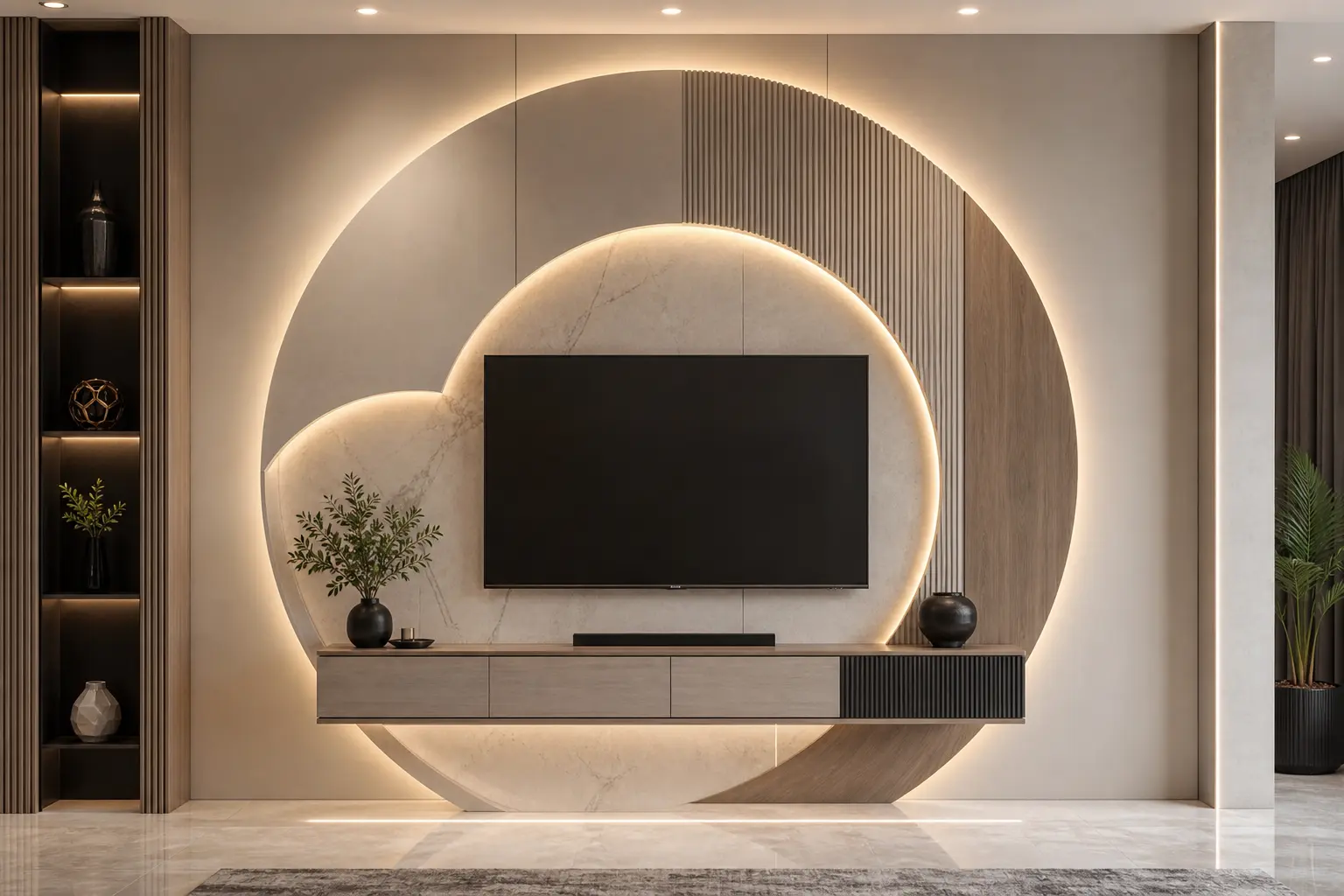
A single ring doesn’t have to use just one material. Combining a wood inner ring with a stone or plaster outer edge adds depth and makes the partition feel custom designed rather than off the shelf.
Keep the transition between materials clean and deliberate, ideally along a visible seam or reveal line, so the mix reads as intentional layering rather than a mismatched patch job. A contrasting metal trim at the seam can reinforce that intentionality even further.
10. Balance the Round Shape With Straight Lines Nearby

A circular partition stands out more when it’s surrounded by straight lined furniture and architecture. Rectangular sofas, square coffee tables, and linear shelving all create contrast that makes the curve feel deliberate rather than random.
Too many curved elements throughout the room can dilute the impact of the partition itself. Save the round shapes for a few key pieces, and let the circular TV wall remain the standout feature.
Mistakes to Avoid
- Sizing the ring too small for the TV, which makes the whole partition look cramped
- Skipping structural planning for wall mounted rings, risking an unstable install
- Using cool toned lighting that clashes with a warm wood or stone finish
- Placing the partition somewhere it blocks natural walking paths through the room
- Overloading the space with too many round shapes, which dilutes the partition’s impact
FAQ
How much clearance does a circular TV partition need? Leave at least a few inches of space around the TV within the ring, and account for extra depth if the design includes backlighting or trim.
Can a circular TV wall work in a small living room? Yes, especially a smaller wall mounted panel rather than a full floor to ceiling partition, which suits tighter spaces better.
Is a freestanding partition as sturdy as a built in one? A well designed freestanding unit with a wide base can be quite stable, though a built in partition generally offers more permanence.
What material works best for a modern, minimalist look? Wood or a light stone finish tends to read as more minimalist than heavily patterned materials or bold color choices.
Does a circular partition work well in an open concept home? Yes, it’s one of the better options for open layouts, since it divides space visually without fully closing off sightlines.
Conclusion
A circular TV wall partition gives you the best of both worlds: a defined spot for the TV and a room divider that doesn’t close off an open floor plan. Wood, stone, or metal all add a certain softness to the round shape. Straight walls simply can’t match that same effect.